


A New Kind of AI Launch
For years, AI model launches followed a predictable pattern: a company builds a new model, runs safety evaluations internally, and ships it to the public. That pattern is changing.
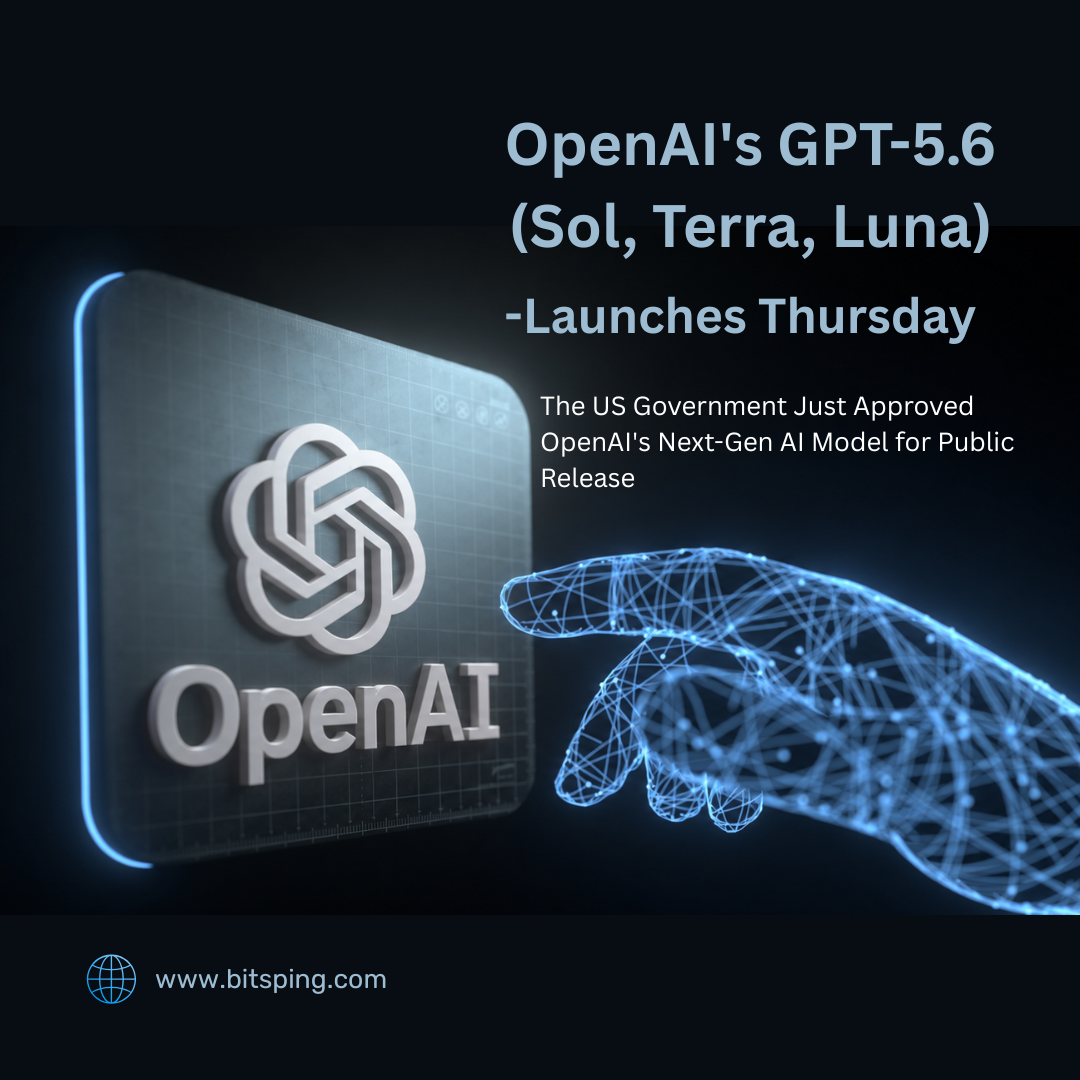
This week, OpenAI announced that its most capable AI model family yet — GPT-5.6, released in three tiers called Sol, Terra, and Luna — will become publicly available on Thursday, July 9, 2026. What makes this launch notable isn’t the model itself, but the road it took to get here.
The Delay, Explained
GPT-5.6 was first previewed to the public in late June 2026, but access was tightly restricted. Rather than opening the model to developers and businesses broadly, OpenAI limited early access to roughly 20 vetted partner organizations, whose participation was shared directly with U.S. government officials.
The reason: growing concern in Washington that the most advanced AI systems could be misused, particularly in cybersecurity contexts. Under the Preparedness Framework OpenAI uses to evaluate its own models, GPT-5.6 was classified as “High capability” in both cybersecurity and biological/chemical risk categories — a meaningful jump from prior generations, even though it did not cross into the “Critical” risk tier.
This restriction wasn’t arbitrary. It followed an executive order signed by President Trump establishing a voluntary framework under which AI developers could share “covered frontier models” with the U.S. government for up to 30 days of review before releasing them publicly.
What Changed This Week
According to reporting from Axios and confirmed by OpenAI directly, the U.S. Department of Commerce’s Center for AI Standards and Innovation completed additional testing on GPT-5.6 and granted clearance for a broad public release. OpenAI’s own technical experts remained in Washington throughout the review process to address questions as they came up.
The result: Sol (the flagship, most capable tier), Terra (a balanced, mid-cost option), and Luna (the fastest and most affordable tier) will all be available to the public starting Thursday.
This Isn’t an Isolated Case
If this story sounds familiar, it’s because a nearly identical sequence played out with Anthropic just weeks earlier. Anthropic’s advanced models, Mythos 5 and Fable 5, were abruptly disabled for all users on June 12, 2026, following a U.S. export control order tied to the same national security concerns. The Department of Commerce lifted those restrictions on June 30, and Anthropic restored public access to Fable 5 by July 1 — after agreeing to implement additional safeguards. Mythos 5 itself, designed with cybersecurity applications in mind, remains available only to a small number of trusted organizations under continued review.
Two of the industry’s leading AI labs, going through the same government checkpoint within weeks of each other, signals something bigger than a single company’s product cycle.
The Bigger Picture: A New Checkpoint for Frontier AI
What we’re witnessing is the early formation of a government review layer sitting between “model is ready” and “model is public” — something that essentially didn’t exist for previous AI generations.
A few reasons this is happening now:
- Cybersecurity capability has jumped meaningfully. OpenAI itself has acknowledged that GPT-5.6 shows a significant increase in its ability to find and help exploit software vulnerabilities compared to earlier models, even if it can’t yet reliably execute full autonomous attacks.
- The U.S. and China are both racing on frontier AI, and each side is wary of the other gaining an edge through systems capable of accelerating cyberattacks on critical, often outdated, infrastructure. Notably, Chinese authorities have reportedly been holding similar discussions about restricting overseas access to their own top AI models.
- There’s no established playbook yet. The current review process is described by U.S. officials and the companies themselves as a temporary, voluntary arrangement — not a long-term regulatory system. OpenAI has publicly stated it doesn’t see this kind of ad hoc government access process as a sustainable long-term model.
What This Means Going Forward
For businesses, developers, and marketers who rely on frontier AI tools, this shift is worth paying attention to. It suggests:
- Model releases may become less predictable. A “launch date” announced by an AI lab could shift based on government review timelines, not just internal readiness.
- Access tiers will likely become more common. Expect more staged rollouts — trusted partners first, broader public access later — rather than same-day launches for everyone.
- Governance and AI capability are now linked at the release stage, not just after deployment. This is a meaningful departure from how software has traditionally been shipped.
Whether this becomes the long-term model for how frontier AI reaches the public, or a temporary bridge while formal regulation catches up, remains to be seen. But for anyone building strategy around AI tools, it’s a trend worth watching closely — because the pace of access, not just the pace of innovation, is now part of the equation.
This article reflects publicly reported information as of July 8, 2026. Details around AI model access and government review processes are evolving and may change.